

10 Things You Might Not Know About Chickens
Disclosure: This post may contain affiliate links
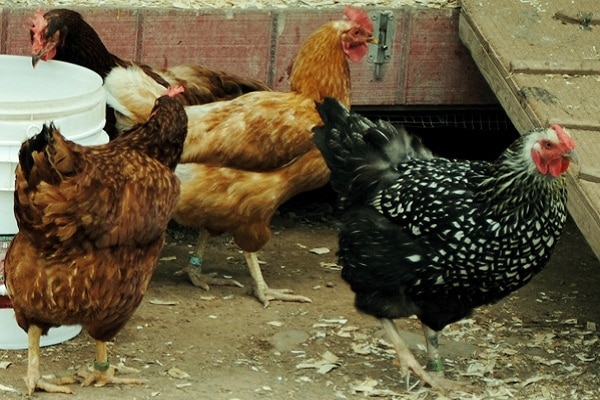
In honour of International Respect for Chickens' Day, I had decided to share 10 things you might not have known about chickens!
What's in this post
Share This Story!
10 Things You Might Not Know About Chickens
By Shannon Alberta, Guest Contributor
May 4th is United Poultry Concern’s Annual ‘International Respect for Chickens‘ Day, a day intended to celebrate the majesty of chickens and demand an end to the horrifying ways we use them. In honour of the day, I had decided to share 10 things you might not have known about chickens! I’ve decided to guest post it here, because of the fantastic feedback, and how damn awesome chickens are!
10 Things You Might Not Know About Chickens
1 ) Unlike popular portrayals of chickens being ‘stupid’ or ‘robotic’, they can distinguish more than 80 members of their own species!
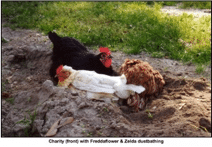
Photo: United Poultry Concerns
2 ) They frequently sun bathe (just like your cat or dog!) But they also give themselves regular dust baths to keep their feathers in good condition and to fight off potential bacteria. While this is a rather utilitarian explanation, I’d like to believe that just like drawing a bath for oneself might seem like a matter of mere hygiene to an observer, we all know that laying in a warm bath tub is relaxing and divine.
3 ) They experience REM (rapid eye movement) sleep, which indicates that they dream, just like we do.
4 ) They have full-color vision and highly developed hearing that assists them in locating and identifying flock members over large areas.
5 ) They originated from the foothills of the Himalayan Mountains and the tropical forests of Southeast Asia, where their habitat consisted of dense foliage, vibrant colors and a wide variety of sounds. These ancestors laid an average of 10-15 eggs per year, a far cry from the 300+/year produced by today’s selectively and genetically bred chickens, whose bones are chronically osteoporotic as a result.
6 ) Even after periods of separation, chickens recognize each other as individuals, demonstrating their impressive memories. Upon reentry, a chicken who has been separated from her flock is treated like an old friend, not a new member.
7 ) Throughout history, hens have been notably celebrated for their ability (and willingness) to defend their young from predators, which makes it all the more surprising (and inaccurate) that the term ‘chicken’ describes someone who lacks bravery.
8 ) Most chickens don’t get to make eye contact with humans, however it is understood as crucial in order to form a friendship with them. Too often chickens only see shoes and legs, not the eyes of a person. Karen Davis even remarks at the difference between the way that chickens raised as pets versus chickens liberated from farms respond to human eye contact initially.
9 ) According to Davis, chickens have many different distinct sounds which include: peeps (made 24 hours before a chick is hatched, it starts to peep to communicate to its mother and siblings that it’s ready to emerge from the shell; this synchronizes the hatching of baby chicks); peeps and clucks (as soon as the chicks are born, the family explores all the while communicating back and forth using peep and clucks; the mother counts the various peeps and notes the emotional tones of their voices); nesting call (when a hen is ready to lay an egg she gives a nesting call to her mate, inviting him to establish a nesting site with her); gentle squawks (when the rooster is a distance away while searching for a nesting site, she squawks gently with diminishing intensity to bring the rooster back while she is more vulnerable away from her flock); egg cackles (after laying her egg, the hen makes an excited cackle to announce her ‘happy accomplishment’ and this brings the rooster to her side); the ‘come over here’ squawk (more of a demand than a request, for her rooster partner to rejoin her); soft trills and peeps (content and relaxed sounds); the ‘piping voice of woe‘ (when bored or restricted in movement and activity); and the ‘huddle of peace and well-being‘ (when they often sing at the end of a busy day while settling into their perches).
10 ) Chickens have pain receptors which provides neurophysiological evidence of a chicken’s ability to feel pain and distress. Suddenly the impersonal understanding of the life of a battery hen becomes viscerally personal:
I am a battery hen. I live in a cage so small I cannot stretch my wings. I am forced to stand night and day on a sloping wire mesh floor that painfully cuts into my feet. The cage walls tear my feathers, forming blood blisters that never heal. The air is so full of ammonia that my lungs hurt and my eyes burn and I think I am going blind. As soon as I was born, a man grabbed me and sheared off part of my beak with a hot iron, and my little brothers were thrown into trash bags as useless alive.
My mind is alert and my body is sensitive and I should have been richly feathered. In nature or even a farmyard I would have had sociable, cleansing dust baths with my flock mates, a need so strong that I perform “vacuum” dust bathing on the wire floor of my cage. Free, I would have ranged my ancestral jungles and fields with my mates devouring plants, earthworms and insects from sunrise to dusk. I would have exercised my body and expressed my nature, and I would have given, and received, pleasure as a whole being. I am only a year old, but I am already a “spent hen.” Humans, I wish I were dead, and soon I will be dead. Look for pieces of my wounded flesh wherever chicken pies and soups are sold. – Karen Davis
Related Posts

8 Comments
Leave A Comment
HELLO! I'm KD Angle-Traegner.

Writer, activist, and founder of Four Urban Paws Sanctuary. I’m on a mission to help people live a vegan life. Read more about KD…

Rufus The Rooster
12Mar2018.
I live in a farming area in Southern Ontario and my neighbours are Snowbirds; last spring they bought chickens that were used for eggs and meat; and by the end of December the chickens were supposed to be gone before my neighbours left for the winter. Well, a rooster and two hens settled in the trees every night and didn’t return to the coop at night to get caught. I plow a few driveways during the winter season, including theirs; and when they were about to leave, they asked me to keep the feeder stocked so the runaway chickens wouldn’t starve.
Well, after about a month or so, only the rooster was around, sitting at the back of the coop, looking very lonely, the hens probably laid eggs on the ground outside of the coop and while trying to hatch them, more than likely became food for the wildlife around here.
Whenever I went to fill the feeder and he was around, I talked to him (about 4 times in all), sometimes for quite awhile as I shovelled the snow to be able to open the gate to get into the pen. The coop is a little house with a four foot fence all around it and the chickens just flew in and out over the fence as they pleased.
Two weeks ago, I walked out of my house and there’s the rooster. He somehow found me, our homes are around 600 feet apart with plenty of spruce trees in between. I think he got too lonely and followed the sound of my tractor because that’s what I used whenever I went over to plow and check on him. And I think I was using the tractor the day before he showed up. At first I thought he’d go back but the next day he was still here and seemed to keep me in his sight, but at a distance, as I worked around the house. Since he wasn’t going anywhere, I put down food and water for him.
He follows me around. Which ever side of the house I go in and out of as I’m working, that’s the side he’ll hang around. If I walk down the driveway, he’ll follow me while staying in the bushes. He has settled in every night in the tall spruce trees in front of the house so that is where I have been feeding and watering him. As daylight breaks, he’ll start crowing, I go out to give him something to eat to shut him up and he’ll be waiting right at the front door.
This evening, while I was working at the dining table which is on the other side of the house, I caught movement in my peripheral vision and there he was at the garden door, looking in at me.
Our cat & dog have accepted him and they hang around the porch together without any trouble.
His name is now Rufus, he looks like a white Leghorn. Last week the weather called for -9°C at night without the wind chill factor; I was worried about him so I quickly built him a big bird house out of scrap plywood, put straw in it and tied it up in the trees where he roosts. While I was up on the ladder, he was in the next tree watching me. The next morning he was on a branch the in front of the box. I haven’t seen him go into it but now he goes up and sits near it every night. Before that, he would roost in different trees.
A few days ago I screwed a branch onto a post in the garden as a perch for him, he was watching me the whole time and after I was done I stood there tapping it, trying to show him that it was for him. I know that he didn’t understand, but honestly, the looks he had, turning his head to look at me then to look at the perch over and over, I’d swear he was trying his darnedest to understand me. After I walked away, he walked around the post looking up at the branch. It was fascinating watching him. Of course, he still hasn’t used it.
I realize that I mean food to him but I’m also quite sure that he likes me as much as I like him or he wouldn’t follow me around away from the food. After reading your article, I now look at his eyes while talking to him, he starts to talk back in low cooing sounds and looks right at my face.
It’s quite an amazing feeling and a privilege when an animal just chooses to like you. We have had many animals, all cats & dogs; and I have been lucky to have had that privilege a few times and it is wonderful each time. This time it’s a chicken, who’d a thunk it?
Wondering whether a chicken is a mammal or a bird. Read on to know more. https://askopinion.com/are-chickens-mammals-or-birds
Has the question whether the chicken is a mammal or a bird become a dilemma for you just like the infamous ‘which came first’ question.
To answer your query whether chickens are mammals or are they birds, we need to understand the basic difference between the two animal group.
Get to know more about chickens here: https://askopinion.com/are-chickens-mammals-or-birds
I have to respectfully disagree with #6 – “Even after periods of separation, chickens recognize each other as individuals, demonstrating their impressive memories. Upon reentry, a chicken who has been separated from her flock is treated like an old friend, not a new member.”
I keep hens on my property and one had to stay at the vet for a week and she was not treated as an old friend but very much like a new member. Even if they do recognize, her, her level in the pecking order was reduced and she hasn’t been treated the same by the “higher ups” since she’s returned over 6 months ago.
[…] Chickens – Think Differently About Sheep* 10 Fascinating Facts About Chickens – Care2 10 Things You Might Not Know About Chickens – Your Daily Vegan Broiler Chickens – Farm Animal Rescue Chicken Meme – […]
Been watching the ustream decorah eagles. blows my mind how everyone coos and awes of these beautiful animals but we don’t give all animals the same respect and place in our world.
Recently reading Walden, by Thoreau, written so far back in our history shows the very economical need for us to be more efficient with all our money and other natural resources
Read it again, not-so ‘smart carnivore’ – it says, ‘like mammals’, not that chickens are mammals. All that meat must have addled your brain.
Shannon – thank you for such a wonderfully informative and compassionate article about chickens. As it did for me, I hope it serves as inspiration to everyone to be more aware that chickens are sentient beings and should be treated with respect and love. Keep up the great work! :)