Posts tagged ‘Guest Contributor: Ann LaGoy’
We’re Still In Trouble

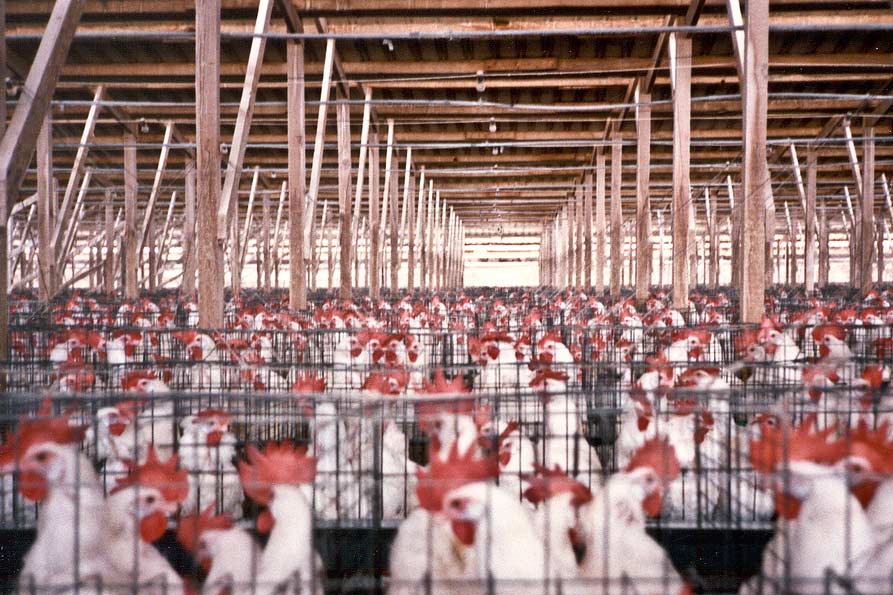
Recently, the Humane Society of the United States and the United Egg Producers came to an agreement. As a team, they will work together to support federal legislation outlining new conditions laying hens endure and the timing and criteria that dictate when and how they will be killed.
Taken from HSUS and UEP joint statement, with my comment in italics:
The proposed legislation would:
• require conventional cages (currently used by more than 90 percent of the egg industry) to be replaced, through an ample phase-in period, with new, enriched housing systems that provide each hen nearly double the amount of space they’re currently allotted. Egg producers will invest an additional $4 billion over the next decade and a half to effect this industry-wide make-over;
The ample phase-in period is ample indeed, 18 years; to be completed by the year 2029. At its highest increase the space each individual hen would have to fight over with other caged hens will expand from slightly less than 8.2″ x 8.2″ to 12″ x 12″. At its lowest increase they would have just shy of 11″x11″; that’s less than .183 sq” per year. As an aside, I don’t give a damn how much the industry is spending to make these measly changes. How many billions are they making off the torment of laying hens?
• require that all egg-laying hens be provided, through the new enriched housing system, with environments that will allow hens to express natural behaviors, such as perches, nesting boxes, and scratching areas;
Approximately one year ago the HSUS made this statement: “While they (furnished cages) do allow caged hens to engage in a larger array of natural behavior patterns, furnished cages do not enable hens the freedom of movement and environmental conditions necessary to achieve an acceptable level of welfare.” The enriched housing system now has hens competing for nests and perches, which are mere inches off the bottom of the cage. Ever heard of pecking order? Why has the HSUS backed down on this?
• mandate labeling on all egg cartons nationwide to inform consumers of the method used to produce the eggs, such as “eggs from caged hens,” “eggs from hens in enriched cages,” “eggs from cage-free hens,” and “eggs from free-range hens”;
The labeling of egg cartons, while useful to the educated few who fully understand what the differences are between cages, enriched cages, cage-free and free range hens will do nothing for individuals who do not. For example, at first blush cage-free conjures up lovely images of hens scurrying about in dirt and field. In reality, these hens may never see the light of day. Cage-free hens can actually live on the second floor of a building; housed by the thousands in one expansive space.
• prohibit feed- or water-withholding molting to extend the laying cycle, a practice already prohibited by the United Egg Producers Certified program adhered to by a majority of egg farmers;
Withholding basic necessities like food and water is deplorable outright; we don’t need to applaud the industry for not sinking to this incredible low. I wonder, however, what protections these hens will have if they are fed correctly (this term used loosely, as feed often contains material not normally eaten by hens) and not laying at all time. Will they be considered “spent” because they are not producing?
• require standards approved by the American Veterinary Medical Association for euthanasia for egg laying hens;
Standards approved by the AVMA have yet to be outlined.
• prohibit excessive ammonia levels in henhouses;
Excessive ammonia levels have yet to be defined.
• prohibit the sale of eggs and egg products nationwide that don’t meet these requirements.
Who will be responsible for overseeing these requirements, and how much funding will be earmarked for that endeavor?
Humane Society of the United States press release:
America’s egg producers have continually worked to improve animal welfare, and we strongly believe our commitment to a national standard for hen welfare is in the best interest of our animals, customers and consumers,” said Bob Krouse, chairman of UEP and an Indiana egg farmer. “We are committed to working together for the good of the hens in our care and believe a national standard is far superior than a patchwork of state laws and regulations that would be cumbersome for our customers and confusing to consumers… A shared understanding of this is where America is going.
I find that harder to choke down than one of your eggs, Mr. Krouse. If this is where America is going, we’re still in trouble. I am also troubled by the agreement: “to pass comprehensive federal legislation for standards of egg production puts a hold on planned ballot measures related to egg-laying hens in both Washington and Oregon.” The agreement that the Humane Society is gleefully announcing ties the hands of more localized government standards that might provide a more reasonable protection for laying hens. Now, they can’t raise the bar, even if they wanted to.
Some actually call this a huge victory. You’ll excuse me if I don’t break out in “We Will Rock You”.
Ann LaGoy, founder of Sound Earth, LLC (soundearth.com), was prompted by chemical poisoning to develop a line of 100% natural cleaning products. She incorporated her love of animals into her company by maintaining that no animal tests or animal ingredients be used in the manufacturing or development of her product line. Ann advocates for the underdog (cat, cow, person, etc). Gaining more awareness in her travels she is happy to shed many unnecessary wastes, and live a healthier lifestyle in mind, body and soul.
You’ll never be guessing what she thinks about chemicals, animals, eats and the travels of her companion dog Frank.
Connect with Ann at her Blog (soundearth.com/SafeClean), Twitter (@safeclean), or FaceBook at Sound Earth.
Ann has been previously featured on Your Daily Vegan! Check out her other posts (and more) by visiting the YDV Contributors Hall of Fame.Do you want to know how to become a Guest Contributor for Your Daily Vegan? Get everything you ever wanted to know about contributing by clicking here.
Barium for Breakfast
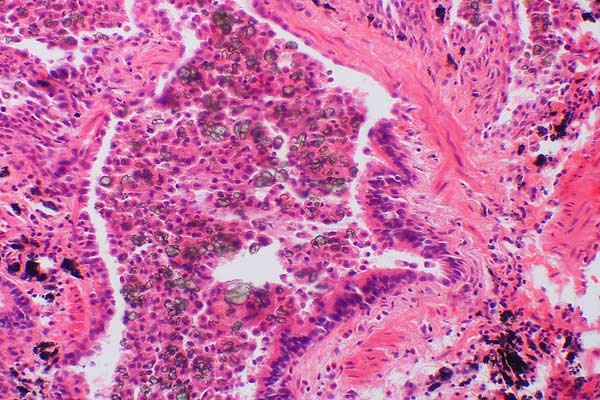
In December 2010 my doctor informed me cancer cells were found on my cervix. I think she was a bit uncertain by my calm receipt of this news. I am not one to panic. I am aware that everyone has cancer; the danger comes when our body cannot eliminate it, as in my case. There were no other details available at that time, and further testing needed to be done.
Next step was a biopsy. No problem. We scheduled. The biopsy divulged that I had a relatively rare form of the rare cancer of the cervix – adenocarcenoma. It was described to me that what makes this cancer such a bugger is that it is glandular; it kind of jumps around by taking the local road (glands) through the organs. My cancer’s breadth could not be detected for certain from the tests performed to that point. More tests needed to be conducted to see exactly where the cancer was lurking.
The scheduled tests were a CT scan and a PET scan, and this is where things got dicey. So far in my journey the procedures had definitive boundaries that existed within my own body. Tissue was taken and examined under a microscope. My only job was to heal from the procedure and remain calm.
For the CT scan I was instructed to arrive at the hospital with a completely empty stomach at 10am. Upon my arrival, I was fed a breakfast of barium. I choked it down; not because of the taste (which wasn’t bad), but because of the knowledge there had been millions of animals tested on to get me to this place. The gravity of my situation, and its affect on other beings, began to hit me.

Three days later I was at the hospital for the PET scan. The nurse informed me a technician would be in shortly to inject me with radioactive material. The technician did arrive, injected me with radioactive material, and advised against holding any young children for the rest of the day. These are not statements one wants to hear who has been speaking out for a decade on the dangers of chemicals, and the horror of animal testing. It was at this point, as I sat in the tiny closet sized room while the chemicals worked their way through my body that I cried. Not only for myself, but for the countless animals that had endured days, weeks, even years of tests so my doctors might have a clue how to treat my cancer. I sat there also knowing that many millions of those animals suffered for not because animal testing is not particularly accurate for human disease. Even if it was, I have never been one to say “better them than me”. I do not accept animal testing in research as collateral damage.
Science has made huge advancements in research. We know better. There are many alternatives to animal testing that are more accurate and can reflect the value at which we hold all animals including humans.
A trend away from animal testing methods is beginning, which will help not only the animals but people, too, particularly in the area of cancer research. Not only are non-animal methods cutting a new path in the testing of cancer-causing chemicals, they are also revolutionizing the search for cancer cures. For years, scientists have used massive numbers of mice, about a million per year, to screen potential anti-cancer drugs. Investigators at the National Cancer Institute (NCI) became concerned that the reason for the general failure of the system is that mice and humans have very different kinds of cancer—and very different ways of reacting to it physiologically. – Neal D. Barnard, M.D., Physicians Committee for Responsible Medicine
I am happy, and relieved, that surgery was my cure. I know that I am incredibly fortunate. My lifestyle does play a part in that fortune. I’ve been vegan for 5 years, don’t smoke, exercise and do body work. There was no need for further treatment. The question still plays in my head, though – what would I have said if there was?

Please take a moment to meet Juno, a beagle who’s life started out in a laboratory with 119 other beagles whom were being used as testing subjects for cosmetics and household items.
June was rescued and tells her story on her Facebook Page.

Ann LaGoy, founder of Sound Earth, LLC (soundearth.com), was prompted by chemical poisoning to develop a line of 100% natural cleaning products. She incorporated her love of animals into her company by maintaining that no animal tests or animal ingredients be used in the manufacturing or development of her product line. Ann advocates for the underdog (cat, cow, person, etc). Gaining more awareness in her travels she is happy to shed many unnecessary wastes, and live a healthier lifestyle in mind, body and soul.
You’ll never be guessing what she thinks about chemicals, animals, eats and the travels of her companion dog Frank.
Connect with Ann at her Blog (soundearth.com/SafeClean), Twitter (@safeclean), or FaceBook at Sound Earth.