

Killing Animals For Art?
This post may contain affiliate links. Please read our disclosure policy.
The US Supreme Court struck down a statute that criminalized the commercial sale or dissemination of animal cruelty, as well as showing wounding or killing animals.
In this article
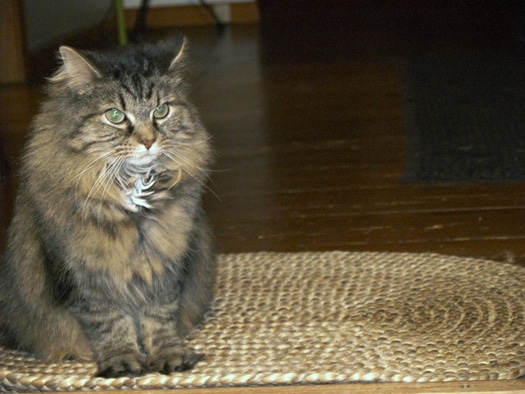
Fuzzy Companion or New Purse?
I came across a petition shared by Alternative Outfitters online, ‘Bring Animal Killing Artist, Katinka Simonse To Justice‘. From the petition:
Katinka Simonse, a 31 year old female living in Amsterdam, has been killing innocent animals and getting away with it. These horrible acts have been looked over because she killed these animals in the name of “Art”. Katinka owns many animals and keeps them in horrible conditions. She owns 60 hamsters in balls and remote controlled guineas pigs. She puts day old male chicks through paper shredders. She writes numbers on the snails in her garden to keep count of them. The act that has angered most people about this case is, in 2004 Katinka Simonse killed her very own cat and then made it into a handbag.
Killing animals for “art” is certainly not a new concept. In fact, it’s something that I wrote about in 2009 for True/Slant.
At that time, over 14,000 artists, art historians, art curators and visual art professionals believed it was a violation of free speech to criminalize the depiction of animal cruelty in works of art – especially for profit (ie: exhibiting in a gallery for sale). The College Art Association (CAA), filed a friend-of-the-court brief with the National Coalition Against Censorship (NCAC) for a Supreme Court hearing in 2009 that was to revisit legislation which would make it illegal to sell depictions of cruelty to animals.
Strangely, the legislation was struck down. From CAA News:
On April 20, 2010, the US Supreme Court struck down, on First Amendment grounds, a federal statute (18 U.S.C. § 48 ) that criminalized the commercial sale, dissemination, and possession of depictions of animal cruelty, as well as of acts showing the wounding or killing of animals.
So, courtesy of our First Amendment rights, we have:
Artist Adel Abdessened opened an exhibit called “Don’t Trust Me” at the San Fransisco Art Institute. The exhibit included six video screens showing a loop of various non-human animals being bludgeoned to death with a sledgehammer next to a brick wall. The non-human animals included a goat, pig, sheep, ox, and a horse. The exhibit was finally taken down after thousands of people protested.
There is a woman in Pennsylvania who gives her cats body piercing so that she can sell them as “Gothic Kitties”? She defends her position saying she, “…didn’t intend to do anything cruel and that she didn’t see any difference between piercing a human and piercing a cat”.
A Florida college senior was charged with animal cruelty when he/she dipped 40 live baby mice into resin, then cut them up into cubes for an art project.
But exploitative art isn’t limited to the US, it’s a global issue.
BMEzine is the world’s largest online body modification community. They have an entire online gallery of modified companion animals. Oh sure, they have the standard bullshit disclaimer saying:
NOTE: BME does not condone the torture and abuse of animals in any way (although we urge you to consider whether these pictures are any worse than torturing, killing, and eating an animal, or worse than cutting a dog’s tail off for looks). These pictures are presented for documentary purposes only and WE DO NOT RECOMMEND OR SUGGEST PIERCING OR OTHERWISE MODIFYING ANIMALS IN ANY WAY!
Really? The mere presence of a large collection of photos displaying piercings and tattoos is only going to spur interest and encourage such behavior.
Then there’s Damien Hirst’s work. One of his most famous pieces is The Physical Impossibility of Death in the Mind of Someone Living. It basically consists of a shark in a vitrine, preserved in formaldehyde. Or, if sharks aren’t your thing, there’s Away from the Flock. Which is a sheep in a glass tank, preserved in formaldehyde. Then, the ever original artist produced Mother and Child Divided. This time the work consisted of a cow and her calf sliced in half and put in a glass tank, preserved in formaldehyde.
Wim Delvoye tattoos pigs in Beijing for a living. He is known for tattooing Louis Vuitton logos, various works, smiley faces, mythical creatures, and more on the backs of the pigs. Then the pigs are sold for thousands of dollars to collectors, who either keep them as companion animals or purchase the tattooed skin of the dead pigs.
Nathalia Edenmont, a Russian artist, kills cats, mice, chickens and rabbits for her surreal still life photographs. Wetterling Gallery in Stockholm was one of the first to show Edenmont’s work. They defended their decision saying,
Most people who see Nathalia’s pictures for the first time are impressed by how beautiful they are….Slowly you realize that the animal is dead, that the animal has died for the sake of the picture…Nathalia’s pictures…are so beautiful – and the insight into the reality behind them gives rise to thoughts of people’s shallowness and double standards. Many of us eat meat, wear leather or use make-up that has been tested on animals, without arousing especially strong reactions. But when a picture shows a dead rabbit, all hell breaks loose…There is nothing illegal in Nathalia’s art. She has killed the animals in as humane a way as possible. Has she been guilty of a moral crime? We do not think so.
Hermann Nitsch from Austria, who uses the entrails of lambs in his ritualistic performances and paints with the blood of non-human animals.
Now we can add Katinka Simonse to the list. Torturing and killing an animal should not be protected by the First Amendment of Free Speech. It’s ludicrous to claim rights while taking away the rights of others. What does it say about a society that has laws to protect people who want to inflict fear and pain on an animal for profit- oh, right. We do this every single day, but instead of calling it art- we call it food.
In art, in life, non-human animals deserve better. This is not a free speech issue. This is a matter of life, and of death.
You might also like



Leave a reply
HELLO! I'm KD Angle-Traegner.

Writer, activist, and founder of Four Urban Paws Sanctuary. I’m on a mission to help people live a vegan life. Read more about KD…
Killing Animals For Art?
This post may contain affiliate links. Please read our disclosure policy.
The US Supreme Court struck down a statute that criminalized the commercial sale or dissemination of animal cruelty, as well as showing wounding or killing animals.
In this article
Fuzzy Companion or New Purse?
I came across a petition shared by Alternative Outfitters online, ‘Bring Animal Killing Artist, Katinka Simonse To Justice‘. From the petition:
Katinka Simonse, a 31 year old female living in Amsterdam, has been killing innocent animals and getting away with it. These horrible acts have been looked over because she killed these animals in the name of “Art”. Katinka owns many animals and keeps them in horrible conditions. She owns 60 hamsters in balls and remote controlled guineas pigs. She puts day old male chicks through paper shredders. She writes numbers on the snails in her garden to keep count of them. The act that has angered most people about this case is, in 2004 Katinka Simonse killed her very own cat and then made it into a handbag.
Killing animals for “art” is certainly not a new concept. In fact, it’s something that I wrote about in 2009 for True/Slant.
At that time, over 14,000 artists, art historians, art curators and visual art professionals believed it was a violation of free speech to criminalize the depiction of animal cruelty in works of art – especially for profit (ie: exhibiting in a gallery for sale). The College Art Association (CAA), filed a friend-of-the-court brief with the National Coalition Against Censorship (NCAC) for a Supreme Court hearing in 2009 that was to revisit legislation which would make it illegal to sell depictions of cruelty to animals.
Strangely, the legislation was struck down. From CAA News:
On April 20, 2010, the US Supreme Court struck down, on First Amendment grounds, a federal statute (18 U.S.C. § 48 ) that criminalized the commercial sale, dissemination, and possession of depictions of animal cruelty, as well as of acts showing the wounding or killing of animals.
So, courtesy of our First Amendment rights, we have:
Artist Adel Abdessened opened an exhibit called “Don’t Trust Me” at the San Fransisco Art Institute. The exhibit included six video screens showing a loop of various non-human animals being bludgeoned to death with a sledgehammer next to a brick wall. The non-human animals included a goat, pig, sheep, ox, and a horse. The exhibit was finally taken down after thousands of people protested.
There is a woman in Pennsylvania who gives her cats body piercing so that she can sell them as “Gothic Kitties”? She defends her position saying she, “…didn’t intend to do anything cruel and that she didn’t see any difference between piercing a human and piercing a cat”.
A Florida college senior was charged with animal cruelty when he/she dipped 40 live baby mice into resin, then cut them up into cubes for an art project.
But exploitative art isn’t limited to the US, it’s a global issue.
BMEzine is the world’s largest online body modification community. They have an entire online gallery of modified companion animals. Oh sure, they have the standard bullshit disclaimer saying:
NOTE: BME does not condone the torture and abuse of animals in any way (although we urge you to consider whether these pictures are any worse than torturing, killing, and eating an animal, or worse than cutting a dog’s tail off for looks). These pictures are presented for documentary purposes only and WE DO NOT RECOMMEND OR SUGGEST PIERCING OR OTHERWISE MODIFYING ANIMALS IN ANY WAY!
Really? The mere presence of a large collection of photos displaying piercings and tattoos is only going to spur interest and encourage such behavior.
Then there’s Damien Hirst’s work. One of his most famous pieces is The Physical Impossibility of Death in the Mind of Someone Living. It basically consists of a shark in a vitrine, preserved in formaldehyde. Or, if sharks aren’t your thing, there’s Away from the Flock. Which is a sheep in a glass tank, preserved in formaldehyde. Then, the ever original artist produced Mother and Child Divided. This time the work consisted of a cow and her calf sliced in half and put in a glass tank, preserved in formaldehyde.
Wim Delvoye tattoos pigs in Beijing for a living. He is known for tattooing Louis Vuitton logos, various works, smiley faces, mythical creatures, and more on the backs of the pigs. Then the pigs are sold for thousands of dollars to collectors, who either keep them as companion animals or purchase the tattooed skin of the dead pigs.
Nathalia Edenmont, a Russian artist, kills cats, mice, chickens and rabbits for her surreal still life photographs. Wetterling Gallery in Stockholm was one of the first to show Edenmont’s work. They defended their decision saying,
Most people who see Nathalia’s pictures for the first time are impressed by how beautiful they are….Slowly you realize that the animal is dead, that the animal has died for the sake of the picture…Nathalia’s pictures…are so beautiful – and the insight into the reality behind them gives rise to thoughts of people’s shallowness and double standards. Many of us eat meat, wear leather or use make-up that has been tested on animals, without arousing especially strong reactions. But when a picture shows a dead rabbit, all hell breaks loose…There is nothing illegal in Nathalia’s art. She has killed the animals in as humane a way as possible. Has she been guilty of a moral crime? We do not think so.
Hermann Nitsch from Austria, who uses the entrails of lambs in his ritualistic performances and paints with the blood of non-human animals.
Now we can add Katinka Simonse to the list. Torturing and killing an animal should not be protected by the First Amendment of Free Speech. It’s ludicrous to claim rights while taking away the rights of others. What does it say about a society that has laws to protect people who want to inflict fear and pain on an animal for profit- oh, right. We do this every single day, but instead of calling it art- we call it food.
In art, in life, non-human animals deserve better. This is not a free speech issue. This is a matter of life, and of death.
You might also like
Leave a reply
-
Yes, please keep bringing this horror to the public’s attention. Killing, especially for messaging of any form is a psychosis – Twisted and cruel
-
A few people below – perhaps friends of the artist – have sought to defend her killing of animals for art. This is nonsense. I am vegan and don’t eat animal flesh, but even I can see the plain difference between killing for food (as lions do, for example) and for so-called, sick, art.
This woman should be stopped
-
No-one who cares about other living beings will argue against the right of an artist to use their work to protest animal cruelty. With that said, and after examining many comments and several websites and letters and the laws of the Netherlands regarding animals, I find that Ms. Simonse is NOT deserving of a pass on her horrific acts of murder, first of a pet cat who apparently trusted her and then of many other animals. Everyone wants to live. It may be kind to let a pet go when it is old and sick, but it shows no respect to then chop up the pet and use it for a handbag, and it is criminally insane to kill other living beings, even if you are protesting the killing that someone else has done. You don’t join the gang to protest their activities. This woman is breaking the law, is flaunting her contempt of others’ outrage at her crimes by printing them in a book she also thinks is art, and is causing horror, pain, and fear both to her victims and to the public in general who cannot accept her twisted excuses for what she has done. There is not a fine line between art and murder; there is a huge, mile-wide line between art and murder, and Ms. Simonse is only apparently fooling a few. The rest of us know that she could certainly use art to protest animal cruelty in the manner a true artist would have, which would not include causing death herself.
-
Es increible,la gilipollez humana…Señores,he estudiado bellas artes, osea, no me pueden decir que no entiendo de ello.Allí me enseñaron, que el arte es belleza,jamás tortura ( por ello lo cursé),no me vengan con mamarrachadas de que somos hipócritas porque hacemos daño a los animales por comer u otras patochadas.Desde siempre la tortura ha sido tortura,tanto en ” las fiestas nacionales ” donde se torture a un animal, como en la industria de la piel y las granjas torturadoras y asesinas, que haberlas ,las hay.
Estoy segura,que esas gentuzas que se llaman artistas,no saben hacer ni el dibujo de un monigote.La taxidermia ha existido desde siempre,pero una cosa es que se te muera un animal querido y sepas momificarlo para no olvidarlo jamás ( cosa que tampoco haría ni loca…) y otra cosa es la psicopatía que tienen esta gente.
Son Calígulas de nuestro tiempo,monstruos horribles,ya que al menos el emperador Calígula amaba de verdad a su caballo y esta gentuza le supera en maldad al cien por cien.Así que la persona que encima le dé a estas mierdas de gente la razón, su incultura es más que probada. Al humano lo hace grande ,la capacidad de amar ,respetar y perdonar, no odiar,torturar,matar y jactarse de ello como si se creyeran Dioses,pués al final son menos que gusanos que crecen en la mierda. -
I can´t believed what she had done with this animals I think she must to see a psychologist!!!!!!
-
Altro che arte..questa gente dovrebbero cancellarla dal mondo… fate a lei quello che fà agli animali.. che schifo veramente!!!
-
Tinkebell’s work is about society’s “blind spot” with regards to animal cruelty. The only animal she killed herself was her cat, which was going to be put down anyway. She chose to do it herself rather than send it to the nice, sterile veterinarian’s office. She chose to take responsibility for the pet that she loved. And if a cow can be leather, why can’t a cat? Why should a beloved pet just vanish forever instead of leaving a reminder behind?
The rest of her animals were purchased dead, because ANIMALS ARE A DISPOSABLE RESOURCE as far as society is concerned. And that is the point she’s making. Those cute little chicks? They were all going to be euthanized. She gave viewers the choice of adopting and raising them, or she would kill them just as the farm would have. They were disposable, just as all animals are, according to our society.
This artist is doing brilliant work pointing out the hypocrisy of our species. We’ll wear the leather from an animal we never had contact with, but if someone makes leather from a pet they’re a MONSTER. -
I think to make a sensationalistic construction is a very lazy way to make a name for oneself as an artist.
Even were I not opposed to depriving an animal of it’s life to make art, I would still be opposed to the reliance on sensationalism and forced confrontation.
Do you think any of these people are capable of executing a competent drawing?
-
KILLING ANIMALS FOR ART: http://articles.sfgate.com/2008-03-30/bay-area/17169017_1_animal-rights-rights-groups-public-forum
-
Kaitlyn, For the most part, animal Cruelty is NOT a crime punishable by prison time in the United States. Most of it goes prosecuted, or people are just fined.
Also, cruelty for art’s sake is cruel. Artists don’t get a free pass for being sadists.
-
I actually agree with the Supreme Court’s decision, if I’m reading it correctly. Depicting an act is not the same thing as committing it. I value freedom of speech for everyone, not just people whose messages I agree with. That’s why the U.S. has a Constitution, though, to protect the rights of perhaps unpopular minorities as well as the more popular views of the majority, or at least in theory.
That being said, there’s a large difference between, say, a painting showing someone killing an animal, and actually killing an animal for “art.” Inflicting real pain and suffering for shock value is never okay. I think that using parts of animals that died from natural causes (bones and naturally shed antlers from the forest, for instance), while still unacceptable to some, is probably far less harmful in the grand scheme of things, however.
-
Animal Cruelty is a crime punishable by prison time in the United States.
-
Wow. That appears to be the longest comment I’ve ever seen. Pretty much a reiteration of the post itself.
I disagree that we should only be focussing our attention on large global issues such as oceanic and atmospheric devastation. While those problems deserve our undivided attention, ignoring smaller, local problems doesn’t help the big picture. In fact, it only makes things worse.
This is why those who do, choose vegan- we know that what we put in our mouth for breakfast, what we cloth our bodies in after our shower (using vegan soap), and every other little choice we make througout our day matters. As someone once said, “If you watch your pennies, you don’t have to worry about your dollars.”
Bringing attention to this art gets people talking about the bigger picture. Hopefully, it becomes a small entry in the annals of art history where the future looks upon it and exclaims, “I can’t believe people did that sick, disgusting, immoral shit and called it ‘art’.” -
I agree with Stella on a lot of points, I also did a lot of research on this girl as well I have to admit that she pushed my way of thinking forward in a sense. The activist in me wants to be so angry at this girl, but the artist in me sees nothing but beauty in her work and in the message of her work. But, to explain this to any activist that does not have an understanding of art may be difficult.
When you are experiencing art you have to look past the norm of society, especially in this case. What she is clearly trying to express is not in favor of animal cruelty, but against it. She feels she needs to use shock value to broaden her audience in hopes that a large number of people receiving her message. Look at it this way; you would have never heard of her if she wasn’t using shock value to get your attention.
Second of all, aside from her cat, all sources claims that all the animals are dead before they come into her possession. She is not going out and killing dogs and cats for her art projects. And every one of her “sick projects” has a simple explanation. PETA just likes to exaggerate for their own shock value.
I would like to put her message in frank terms:
In most circles, taxidermy is socially acceptable; if someone saw a deer head hanging on the wall they would never react the same way one would if it was a dog or cat. But why is this? Why is it socially not acceptable to skin and mount a cat, but we turn the other cheek when a deer is dead on the wall? She is trying to encourage people to question the treatment of ALL animals, not just our beloved house pets.
Same thing goes for her cat purse. Why is it okay to kill a cow for a leather purse and not a cat? She is not encouraging people to walk around with Mittens dead on our shoulders; she is encouraging people to think critically about the dead cow already on our shoulder. A cow that lived a horrible, cruel life before it met its death while her cat lived a loving good.
I obviously don’t agree with either because I do not purchase or use animal products, but again I agree with her message because this is how society thinks.
I don’t think she is pushing for people to wear fur but using a different approach to combating it. I am in no way justifying cruelty to animals. But, if the animals are already dead then what is wrong with her creating art out of them instead of letting it go to waste? But not only that, creating art that is standing up for the blind side of social acceptance that we as vegetarians or vegans stand up for on daily basis?
It’s a crazy way to go about it, but I understand, and to be honest, appreciate it from an artists view
People think it is wrong to eat a lion but not to eat a cow. I see how screwed up that logic is too, so why can’t she express that frustration by showing the huge flaw in our social acceptance of animals.
Again, I am not defending her acts of cruelty, she did kill her cat but her defense against this is that her cat was terminally ill and was going to be put down by a vet. She claims her cat is petrified by the vet and she preferred it die in a comfortable environment. Again, highly exaggerated by PETA. Now, putting your own cat to death is not the social norm, I know, but we are still looking past that for a moment.
Another thing highly exaggerated by PETA is the dead chicks through the paper shredder. She never actually killed a single chick she bought the male chicks — that would have been killed anyways — for her exhibit and told onlookers that if they did not purchase a male chick they all would be put to death by the shredder. She is trying to bring light to this horrible act of killing male chicks at egg farms because of their lack of value because they do not produce eggs. And, in the end not one chick actually died.
And last of all, I think there are way more important things –like the depletion of our oceans or the copious amounts of smog in the air– that we should be combating. Instead of throwing hate at an artist half way across the world that feeds, and in a sense profits, off the negativity we are sending her way. In a way we are supporting her by sending her hate, because she is getting the attention she has set out to receive.
Call me crazy, but the more you examine her work and her character the more you know it is just shock art to get your attention. And it worked.
-
To view the entire petition quoted above (First quote) please visit this link: http://www.change.org/petitions/bring-animal-killing-artist-katinka-simonse-to-justice
Please please please sign and share!! -
Art &^%$*@#$ shmart, these people are so clearly expressing sociopathic tendencies it’s not even possible for me to see it from any other perspective. And then when you factor in that there’s idiots out there calling it “art,” my God…
-
I have great respect for art and the freedom of expression, but art is never more valuable than an animal’s life. Killing animal’s for art should be illegal.
-
After reading this article I decided to read up as much as I could on Katinka. I have followed a vegan diet for 9 years happily and I also do not buy fur or leather. However, I still wear used and vintage fur and leather. Personally I do not have a problem with taxidermy as long as the animal did not die for the purpose of taxidermy. I enjoy the morbid art of Eileen Wunderlich for instance who creates bizarre taxidermy out of roadkill, some of which are cats. I can compare that idea to the art of Joel Peter Witkin for example which I also enjoy.
I am disturbed that Katinka/Tinkebell is purposefully killing animals for her art. I would also be very interested in gaining more information about that. I browsed her website:
http://www.looovetinkebell.com/
which displays a number of dead animals including cats, dogs, chicks, a pony, etc and am wondering how she obtained some of them. Isn’t killing animals in this way illegal in the Netherlands?
What is strange to me is her reasoning. If you take away her art, her points of view are spot on and almost animal friendly. They point out how blind society is to factory farming and even vet cruelty. How animals have become our toys and only the “cute” ones seem to matter to most people. I couldn’t agree with these ideas more. But then to explain these ideas to people, she kills animals.
I mean, I wish everyone could understand the horrors of factory farming but if I tried to explain it by slaughtering say, a pig in public, well I may have gotten a point across but I’ve still killed a pig which makes me no better.
Is that her point? That we are all terrible and she is no better? A worthy point but not one that anything should have to die for. I am still very confused… -
Great article. As disturbing as this is, I find it interesting that so many people do care about and are disturbed by animal cruelty. They may be conditioned to not view meat or leather as the body parts of an animal, but when they see the whole animal being mistreated, they at least do care.
Also, I really can’t consider something to be art unless the artist has demonstrated a level of skill in the creation of their work. Dipping baby mice in resin and cutting them up doesn’t take skill, whereas creating an interesting painting or sculpture or photograph does. Call me a Philistine, but I’m sick of seeing things labelled as art just because it’s something provocative that can be taken in visually. And there doesn’t seem to be any message in these works other than “look at what I can get away with if I call it art”.
-
“Artists” can sometimes take too many liberties in their quests to garner attention.
But this is hardly different than a citizen’s (and unfortunately, a corporation’s) “right” to profit from producing and slaughtering cows, selling burgers from a drive-up window, or making leather bracelets for a craft fair.
Maybe “art” will wake people up to the cruel reality they’ve been ignoring all their lives. -
Such an informative piece on such a disturbing issue. It’s amazing that these “artists” are protected by the very same First Amendment that has been stripped away from those who want to protest animal cruelty and are labeled terrorists.
Thank you for this article.


HELLO! I'm KD Angle-Traegner.
Writer, activist, and founder of Four Urban Paws Sanctuary. I’m on a mission to help people live a vegan life. Read more about KD…
Yes, please keep bringing this horror to the public’s attention. Killing, especially for messaging of any form is a psychosis – Twisted and cruel
A few people below – perhaps friends of the artist – have sought to defend her killing of animals for art. This is nonsense. I am vegan and don’t eat animal flesh, but even I can see the plain difference between killing for food (as lions do, for example) and for so-called, sick, art.
This woman should be stopped
No-one who cares about other living beings will argue against the right of an artist to use their work to protest animal cruelty. With that said, and after examining many comments and several websites and letters and the laws of the Netherlands regarding animals, I find that Ms. Simonse is NOT deserving of a pass on her horrific acts of murder, first of a pet cat who apparently trusted her and then of many other animals. Everyone wants to live. It may be kind to let a pet go when it is old and sick, but it shows no respect to then chop up the pet and use it for a handbag, and it is criminally insane to kill other living beings, even if you are protesting the killing that someone else has done. You don’t join the gang to protest their activities. This woman is breaking the law, is flaunting her contempt of others’ outrage at her crimes by printing them in a book she also thinks is art, and is causing horror, pain, and fear both to her victims and to the public in general who cannot accept her twisted excuses for what she has done. There is not a fine line between art and murder; there is a huge, mile-wide line between art and murder, and Ms. Simonse is only apparently fooling a few. The rest of us know that she could certainly use art to protest animal cruelty in the manner a true artist would have, which would not include causing death herself.
Es increible,la gilipollez humana…Señores,he estudiado bellas artes, osea, no me pueden decir que no entiendo de ello.Allí me enseñaron, que el arte es belleza,jamás tortura ( por ello lo cursé),no me vengan con mamarrachadas de que somos hipócritas porque hacemos daño a los animales por comer u otras patochadas.Desde siempre la tortura ha sido tortura,tanto en ” las fiestas nacionales ” donde se torture a un animal, como en la industria de la piel y las granjas torturadoras y asesinas, que haberlas ,las hay.
Estoy segura,que esas gentuzas que se llaman artistas,no saben hacer ni el dibujo de un monigote.La taxidermia ha existido desde siempre,pero una cosa es que se te muera un animal querido y sepas momificarlo para no olvidarlo jamás ( cosa que tampoco haría ni loca…) y otra cosa es la psicopatía que tienen esta gente.
Son Calígulas de nuestro tiempo,monstruos horribles,ya que al menos el emperador Calígula amaba de verdad a su caballo y esta gentuza le supera en maldad al cien por cien.Así que la persona que encima le dé a estas mierdas de gente la razón, su incultura es más que probada. Al humano lo hace grande ,la capacidad de amar ,respetar y perdonar, no odiar,torturar,matar y jactarse de ello como si se creyeran Dioses,pués al final son menos que gusanos que crecen en la mierda.
I can´t believed what she had done with this animals I think she must to see a psychologist!!!!!!
Altro che arte..questa gente dovrebbero cancellarla dal mondo… fate a lei quello che fà agli animali.. che schifo veramente!!!
Tinkebell’s work is about society’s “blind spot” with regards to animal cruelty. The only animal she killed herself was her cat, which was going to be put down anyway. She chose to do it herself rather than send it to the nice, sterile veterinarian’s office. She chose to take responsibility for the pet that she loved. And if a cow can be leather, why can’t a cat? Why should a beloved pet just vanish forever instead of leaving a reminder behind?
The rest of her animals were purchased dead, because ANIMALS ARE A DISPOSABLE RESOURCE as far as society is concerned. And that is the point she’s making. Those cute little chicks? They were all going to be euthanized. She gave viewers the choice of adopting and raising them, or she would kill them just as the farm would have. They were disposable, just as all animals are, according to our society.
This artist is doing brilliant work pointing out the hypocrisy of our species. We’ll wear the leather from an animal we never had contact with, but if someone makes leather from a pet they’re a MONSTER.
I think to make a sensationalistic construction is a very lazy way to make a name for oneself as an artist.
Even were I not opposed to depriving an animal of it’s life to make art, I would still be opposed to the reliance on sensationalism and forced confrontation.
Do you think any of these people are capable of executing a competent drawing?
KILLING ANIMALS FOR ART: http://articles.sfgate.com/2008-03-30/bay-area/17169017_1_animal-rights-rights-groups-public-forum
Kaitlyn, For the most part, animal Cruelty is NOT a crime punishable by prison time in the United States. Most of it goes prosecuted, or people are just fined.
Also, cruelty for art’s sake is cruel. Artists don’t get a free pass for being sadists.
I actually agree with the Supreme Court’s decision, if I’m reading it correctly. Depicting an act is not the same thing as committing it. I value freedom of speech for everyone, not just people whose messages I agree with. That’s why the U.S. has a Constitution, though, to protect the rights of perhaps unpopular minorities as well as the more popular views of the majority, or at least in theory.
That being said, there’s a large difference between, say, a painting showing someone killing an animal, and actually killing an animal for “art.” Inflicting real pain and suffering for shock value is never okay. I think that using parts of animals that died from natural causes (bones and naturally shed antlers from the forest, for instance), while still unacceptable to some, is probably far less harmful in the grand scheme of things, however.
Animal Cruelty is a crime punishable by prison time in the United States.
Wow. That appears to be the longest comment I’ve ever seen. Pretty much a reiteration of the post itself.
I disagree that we should only be focussing our attention on large global issues such as oceanic and atmospheric devastation. While those problems deserve our undivided attention, ignoring smaller, local problems doesn’t help the big picture. In fact, it only makes things worse.
This is why those who do, choose vegan- we know that what we put in our mouth for breakfast, what we cloth our bodies in after our shower (using vegan soap), and every other little choice we make througout our day matters. As someone once said, “If you watch your pennies, you don’t have to worry about your dollars.”
Bringing attention to this art gets people talking about the bigger picture. Hopefully, it becomes a small entry in the annals of art history where the future looks upon it and exclaims, “I can’t believe people did that sick, disgusting, immoral shit and called it ‘art’.”
I agree with Stella on a lot of points, I also did a lot of research on this girl as well I have to admit that she pushed my way of thinking forward in a sense. The activist in me wants to be so angry at this girl, but the artist in me sees nothing but beauty in her work and in the message of her work. But, to explain this to any activist that does not have an understanding of art may be difficult.
When you are experiencing art you have to look past the norm of society, especially in this case. What she is clearly trying to express is not in favor of animal cruelty, but against it. She feels she needs to use shock value to broaden her audience in hopes that a large number of people receiving her message. Look at it this way; you would have never heard of her if she wasn’t using shock value to get your attention.
Second of all, aside from her cat, all sources claims that all the animals are dead before they come into her possession. She is not going out and killing dogs and cats for her art projects. And every one of her “sick projects” has a simple explanation. PETA just likes to exaggerate for their own shock value.
I would like to put her message in frank terms:
In most circles, taxidermy is socially acceptable; if someone saw a deer head hanging on the wall they would never react the same way one would if it was a dog or cat. But why is this? Why is it socially not acceptable to skin and mount a cat, but we turn the other cheek when a deer is dead on the wall? She is trying to encourage people to question the treatment of ALL animals, not just our beloved house pets.
Same thing goes for her cat purse. Why is it okay to kill a cow for a leather purse and not a cat? She is not encouraging people to walk around with Mittens dead on our shoulders; she is encouraging people to think critically about the dead cow already on our shoulder. A cow that lived a horrible, cruel life before it met its death while her cat lived a loving good.
I obviously don’t agree with either because I do not purchase or use animal products, but again I agree with her message because this is how society thinks.
I don’t think she is pushing for people to wear fur but using a different approach to combating it. I am in no way justifying cruelty to animals. But, if the animals are already dead then what is wrong with her creating art out of them instead of letting it go to waste? But not only that, creating art that is standing up for the blind side of social acceptance that we as vegetarians or vegans stand up for on daily basis?
It’s a crazy way to go about it, but I understand, and to be honest, appreciate it from an artists view
People think it is wrong to eat a lion but not to eat a cow. I see how screwed up that logic is too, so why can’t she express that frustration by showing the huge flaw in our social acceptance of animals.
Again, I am not defending her acts of cruelty, she did kill her cat but her defense against this is that her cat was terminally ill and was going to be put down by a vet. She claims her cat is petrified by the vet and she preferred it die in a comfortable environment. Again, highly exaggerated by PETA. Now, putting your own cat to death is not the social norm, I know, but we are still looking past that for a moment.
Another thing highly exaggerated by PETA is the dead chicks through the paper shredder. She never actually killed a single chick she bought the male chicks — that would have been killed anyways — for her exhibit and told onlookers that if they did not purchase a male chick they all would be put to death by the shredder. She is trying to bring light to this horrible act of killing male chicks at egg farms because of their lack of value because they do not produce eggs. And, in the end not one chick actually died.
And last of all, I think there are way more important things –like the depletion of our oceans or the copious amounts of smog in the air– that we should be combating. Instead of throwing hate at an artist half way across the world that feeds, and in a sense profits, off the negativity we are sending her way. In a way we are supporting her by sending her hate, because she is getting the attention she has set out to receive.
Call me crazy, but the more you examine her work and her character the more you know it is just shock art to get your attention. And it worked.
To view the entire petition quoted above (First quote) please visit this link: http://www.change.org/petitions/bring-animal-killing-artist-katinka-simonse-to-justice
Please please please sign and share!!
Art &^%$*@#$ shmart, these people are so clearly expressing sociopathic tendencies it’s not even possible for me to see it from any other perspective. And then when you factor in that there’s idiots out there calling it “art,” my God…
I have great respect for art and the freedom of expression, but art is never more valuable than an animal’s life. Killing animal’s for art should be illegal.
After reading this article I decided to read up as much as I could on Katinka. I have followed a vegan diet for 9 years happily and I also do not buy fur or leather. However, I still wear used and vintage fur and leather. Personally I do not have a problem with taxidermy as long as the animal did not die for the purpose of taxidermy. I enjoy the morbid art of Eileen Wunderlich for instance who creates bizarre taxidermy out of roadkill, some of which are cats. I can compare that idea to the art of Joel Peter Witkin for example which I also enjoy.
I am disturbed that Katinka/Tinkebell is purposefully killing animals for her art. I would also be very interested in gaining more information about that. I browsed her website:
http://www.looovetinkebell.com/
which displays a number of dead animals including cats, dogs, chicks, a pony, etc and am wondering how she obtained some of them. Isn’t killing animals in this way illegal in the Netherlands?
What is strange to me is her reasoning. If you take away her art, her points of view are spot on and almost animal friendly. They point out how blind society is to factory farming and even vet cruelty. How animals have become our toys and only the “cute” ones seem to matter to most people. I couldn’t agree with these ideas more. But then to explain these ideas to people, she kills animals.
I mean, I wish everyone could understand the horrors of factory farming but if I tried to explain it by slaughtering say, a pig in public, well I may have gotten a point across but I’ve still killed a pig which makes me no better.
Is that her point? That we are all terrible and she is no better? A worthy point but not one that anything should have to die for. I am still very confused…
Great article. As disturbing as this is, I find it interesting that so many people do care about and are disturbed by animal cruelty. They may be conditioned to not view meat or leather as the body parts of an animal, but when they see the whole animal being mistreated, they at least do care.
Also, I really can’t consider something to be art unless the artist has demonstrated a level of skill in the creation of their work. Dipping baby mice in resin and cutting them up doesn’t take skill, whereas creating an interesting painting or sculpture or photograph does. Call me a Philistine, but I’m sick of seeing things labelled as art just because it’s something provocative that can be taken in visually. And there doesn’t seem to be any message in these works other than “look at what I can get away with if I call it art”.
“Artists” can sometimes take too many liberties in their quests to garner attention.
But this is hardly different than a citizen’s (and unfortunately, a corporation’s) “right” to profit from producing and slaughtering cows, selling burgers from a drive-up window, or making leather bracelets for a craft fair.
Maybe “art” will wake people up to the cruel reality they’ve been ignoring all their lives.
Such an informative piece on such a disturbing issue. It’s amazing that these “artists” are protected by the very same First Amendment that has been stripped away from those who want to protest animal cruelty and are labeled terrorists.
Thank you for this article.