

Glowing Cats- It’s Not Cute
This post may contain affiliate links. Please read our disclosure policy.
What does the future hold for these glowing cats?
In this article
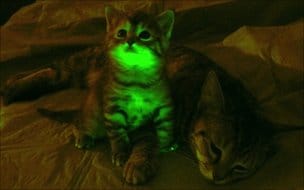
GMO Cat next to non-gmo mother | Photo: BBC News
US and Japanese scientists working at the Mayo Clinic have done some gene splicing in cats. The aim of this work is to make the cats resistant to the feline immunodeficiency virus (FIV), which is similar to HIV, the virus that causes AIDS in humans.
So why the glow? This is from a jellyfish gene spliced into the cat’s gene so that the scientists can basically track the rhesus macaque gene which was also spliced into the cat’s. The rhesus macaque carries this gene which makes it resistant to the AIDS virus.
What does the future hold for these glowing cats? In addition to life in a lab? Infection.
So far, Dr. Poeschla’s team has only tested cells taken from the animals and found they were resistant to FIV. But eventually they plan to expose the cats to the virus and see if they are protected.
It’s not just cats
In 2009, marmosets were genetically modified to glow green and pass the trait onto their children. This was a first for scientists. Though primates that make a glowing protein had been created before, these were the first to keep the change in their bloodlines. Scientists have:
- Yerkes National Primate Research Center, Atlanta, US, created rhesus macaque monkeys with Huntington’s disease. Four of those are still awaiting puberty, and the researchers hope that they will produce a second generation of macaques with the disease.
- Researchers in Taiwan developed green glowing pigs that will mate with ordinary female pigs to create a new generation for much greater numbers of transgenic pigs for use in research.
- Dogs are also used as candidates for research because they have “good communication skills with humans, which enable them to have good response skills to direct orders. They are also easy to handle.” Genetically Modified Beagle, Teagon, was born.
- Dr Monteiro, a US scientist, wanted to investigate the environmental factors that led to wing patterns. Thus, we genetically altered the butterfly.
Origins in Exploitation
Martin Chalfie, Roger Tsien and Osamu Shimomura are the three scientists that made it possible to exploit the genetic mechanism responsible for luminosity in the marine creatures by first discovering the glowing protein (green fluorescent protein – GFP) from jellyfish. Scientists trying to modify an animal will include the gene responsible for GFP to tell them if the modification was successful. It is the same science that has lead laboratories to develop “glowing” rabbits, butterflies, pigs, mice, monkeys, and others.
The scientists were lauded for their work in exploitation with a Noble Prize, a medal, and a diploma.
Why It Matters
Animal testing is unreliable and cruel.
The testing performed on non-human animals, including primates, does not provide accurate and useful information regarding human medicine.
Ending Non-human primate research would benefit human medicine by halting the flow of unreliable data from it, and by diverting research funds to more appropriate and promising methods. These include batteries of human-based tests that provide reliable and relevant information on which to base further research and translate laboratory findings to the clinic: microarrays and other DNA technologies; proteomics and metabolomics; mathematical and computer modelling; epidemiology; human clinical research; myriad in vitro molecular biological techniques; microfluidics devices; scanning technologies, microdosing etc…. in short, technologies that have demonstrably contributed to human medicine. – Jarrod Bailey, Ph.D
Also, don’t be surprised if glowing pets becomes a new trend. Chemyong Jay Ko, an associate professor in the College of Health Sciences at the University of Kentucky said, the “technology could be used for producing a variety of unique cats and dogs, possibly creating a new area of commercial interest.”
Perez Hilton posted this about the glowing kittens, “Curing AIDS and making kittens cuter… we can’t think of a better way for scientists to spend their time.” We obviously have a long way to go in educating people.
How You Can Help
Due to current governmental regulations around the globe, it is nearly impossible to avoid medications that have been tested on animals. Refusing medications for ethical reasons will do little to deter pharmaceutical companies from using animal experimentation to determine the safety and efficacy of new medications. More funding must be dedicated to the development of better, more reliable, human-based drug testing.
Help affect change:
- Contact your governmental agency that is responsible for animal testing to voice opposition
- Support charities that fund only non-animal research
- Buy only cruelty-free
- Share and Tweet to help educate and raise awareness about animal testing
You might also like



Leave a reply
HELLO! I'm KD Angle-Traegner.

Writer, activist, and founder of Four Urban Paws Sanctuary. I’m on a mission to help people live a vegan life. Read more about KD…
Glowing Cats- It’s Not Cute
This post may contain affiliate links. Please read our disclosure policy.
What does the future hold for these glowing cats?
In this article
GMO Cat next to non-gmo mother | Photo: BBC News
US and Japanese scientists working at the Mayo Clinic have done some gene splicing in cats. The aim of this work is to make the cats resistant to the feline immunodeficiency virus (FIV), which is similar to HIV, the virus that causes AIDS in humans.
So why the glow? This is from a jellyfish gene spliced into the cat’s gene so that the scientists can basically track the rhesus macaque gene which was also spliced into the cat’s. The rhesus macaque carries this gene which makes it resistant to the AIDS virus.
What does the future hold for these glowing cats? In addition to life in a lab? Infection.
So far, Dr. Poeschla’s team has only tested cells taken from the animals and found they were resistant to FIV. But eventually they plan to expose the cats to the virus and see if they are protected.
It’s not just cats
In 2009, marmosets were genetically modified to glow green and pass the trait onto their children. This was a first for scientists. Though primates that make a glowing protein had been created before, these were the first to keep the change in their bloodlines. Scientists have:
- Yerkes National Primate Research Center, Atlanta, US, created rhesus macaque monkeys with Huntington’s disease. Four of those are still awaiting puberty, and the researchers hope that they will produce a second generation of macaques with the disease.
- Researchers in Taiwan developed green glowing pigs that will mate with ordinary female pigs to create a new generation for much greater numbers of transgenic pigs for use in research.
- Dogs are also used as candidates for research because they have “good communication skills with humans, which enable them to have good response skills to direct orders. They are also easy to handle.” Genetically Modified Beagle, Teagon, was born.
- Dr Monteiro, a US scientist, wanted to investigate the environmental factors that led to wing patterns. Thus, we genetically altered the butterfly.
Origins in Exploitation
Martin Chalfie, Roger Tsien and Osamu Shimomura are the three scientists that made it possible to exploit the genetic mechanism responsible for luminosity in the marine creatures by first discovering the glowing protein (green fluorescent protein – GFP) from jellyfish. Scientists trying to modify an animal will include the gene responsible for GFP to tell them if the modification was successful. It is the same science that has lead laboratories to develop “glowing” rabbits, butterflies, pigs, mice, monkeys, and others.
The scientists were lauded for their work in exploitation with a Noble Prize, a medal, and a diploma.
Why It Matters
Animal testing is unreliable and cruel.
The testing performed on non-human animals, including primates, does not provide accurate and useful information regarding human medicine.
Ending Non-human primate research would benefit human medicine by halting the flow of unreliable data from it, and by diverting research funds to more appropriate and promising methods. These include batteries of human-based tests that provide reliable and relevant information on which to base further research and translate laboratory findings to the clinic: microarrays and other DNA technologies; proteomics and metabolomics; mathematical and computer modelling; epidemiology; human clinical research; myriad in vitro molecular biological techniques; microfluidics devices; scanning technologies, microdosing etc…. in short, technologies that have demonstrably contributed to human medicine. – Jarrod Bailey, Ph.D
Also, don’t be surprised if glowing pets becomes a new trend. Chemyong Jay Ko, an associate professor in the College of Health Sciences at the University of Kentucky said, the “technology could be used for producing a variety of unique cats and dogs, possibly creating a new area of commercial interest.”
Perez Hilton posted this about the glowing kittens, “Curing AIDS and making kittens cuter… we can’t think of a better way for scientists to spend their time.” We obviously have a long way to go in educating people.
How You Can Help
Due to current governmental regulations around the globe, it is nearly impossible to avoid medications that have been tested on animals. Refusing medications for ethical reasons will do little to deter pharmaceutical companies from using animal experimentation to determine the safety and efficacy of new medications. More funding must be dedicated to the development of better, more reliable, human-based drug testing.
Help affect change:
- Contact your governmental agency that is responsible for animal testing to voice opposition
- Support charities that fund only non-animal research
- Buy only cruelty-free
- Share and Tweet to help educate and raise awareness about animal testing
You might also like
Leave a reply
-
i must say charlotte, the author proclaims herself as “BADASS”
Is
she really a reliable source? This badass states states that we should
experiments on humans which is a logical response to this , however, you
have to think about what if they did.
Well here are a couple of points to think about:
*Do we have the resources and money to pay YOU for letting us test you?
*Dogs
and cats produce more than one offspring making it more acceptable to
experiment on in comparison to humans beacause we only have 1 egg to
produce 1 child or sometimes 2 or more children. thus making it
unacceptable to mess with the genetics of a human not only that but the
incubation in the womb is too long.
* So choices ( let them do what there going to do because the government isn’t paying attention and frankly doesnt care )
OR (Go have a child and let scientist do “inhumane things” to your
unborn fetus or your just born child or sacrifice your life in the name
of scientist)
i don’t care what your choice is but i know you will
not back your words because we as humans value life over anything. so
take your self righteous words and either hold them true or stop
talking. Animals Have rights true yes but your focusing on the wrong
groups, animal testing in the name of science such as this is more than
acceptable, however, your focus should be Axe, Dove, and all the other
hair care and beauty products that female activist may and/or may not
support. THEY are the real monsters. Most animals die from Anaphylaxis
which mind you is much worse. i cant tell you Right now that i would
rather be electrocuted to death than go through Anaphylaxis then be
discarded like a dirty tissue. You may not agree with my points but i am
in college and i am for animal experimentation for the right reasons i
have studied this and there is more to the picture than this “BADASS”
complaining because scientists are doing what they can to help cure your
cat or dog. “Dont bite the hand that feeds” because it wont feed you
again. -
This is horrible; very disturbing!
-
I can’t get over how sick these scientists are, thinking that (often marginal) advances in scientific knowledge justify infecting cats with an HIV-like virus, or that “hey, dogs trust us more than other animals, so that means that we should exploit them for experiments.” They trust us because they have the sort of emotions which most people would say make it unethical to test on non-consenting humans and primates, for crying out loud!
Also, as a molecular biologist (who studies plants, mind you), I have to compliment you on your ability to write about science in a way that’s easy to understand! I also recommend that readers who live in areas with a university look into campus animal rights groups. My university has an anti-animal testing group, and they’ve done a great job telling students and the public about unethical research which is often otherwise very hush-hush and only known about in scientific circles.


HELLO! I'm KD Angle-Traegner.
Writer, activist, and founder of Four Urban Paws Sanctuary. I’m on a mission to help people live a vegan life. Read more about KD…

i must say charlotte, the author proclaims herself as “BADASS”
Is
she really a reliable source? This badass states states that we should
experiments on humans which is a logical response to this , however, you
have to think about what if they did.
Well here are a couple of points to think about:
*Do we have the resources and money to pay YOU for letting us test you?
*Dogs
and cats produce more than one offspring making it more acceptable to
experiment on in comparison to humans beacause we only have 1 egg to
produce 1 child or sometimes 2 or more children. thus making it
unacceptable to mess with the genetics of a human not only that but the
incubation in the womb is too long.
* So choices ( let them do what there going to do because the government isn’t paying attention and frankly doesnt care )
OR (Go have a child and let scientist do “inhumane things” to your
unborn fetus or your just born child or sacrifice your life in the name
of scientist)
i don’t care what your choice is but i know you will
not back your words because we as humans value life over anything. so
take your self righteous words and either hold them true or stop
talking. Animals Have rights true yes but your focusing on the wrong
groups, animal testing in the name of science such as this is more than
acceptable, however, your focus should be Axe, Dove, and all the other
hair care and beauty products that female activist may and/or may not
support. THEY are the real monsters. Most animals die from Anaphylaxis
which mind you is much worse. i cant tell you Right now that i would
rather be electrocuted to death than go through Anaphylaxis then be
discarded like a dirty tissue. You may not agree with my points but i am
in college and i am for animal experimentation for the right reasons i
have studied this and there is more to the picture than this “BADASS”
complaining because scientists are doing what they can to help cure your
cat or dog. “Dont bite the hand that feeds” because it wont feed you
again.
This is horrible; very disturbing!
I can’t get over how sick these scientists are, thinking that (often marginal) advances in scientific knowledge justify infecting cats with an HIV-like virus, or that “hey, dogs trust us more than other animals, so that means that we should exploit them for experiments.” They trust us because they have the sort of emotions which most people would say make it unethical to test on non-consenting humans and primates, for crying out loud!
Also, as a molecular biologist (who studies plants, mind you), I have to compliment you on your ability to write about science in a way that’s easy to understand! I also recommend that readers who live in areas with a university look into campus animal rights groups. My university has an anti-animal testing group, and they’ve done a great job telling students and the public about unethical research which is often otherwise very hush-hush and only known about in scientific circles.